Routing Concepts
MSD lines route themselves like cable raceways on a circuit board: they find their own way around obstacles, bundle together when they're heading the same direction, and avoid cutting across each other when a small detour is cheap enough. This page is the short version of how the router decides a path — a mental model, not the full config reference.
Just want the config knobs?
This page explains the concepts. For every mode, field, and tunable default, see Line Routing & Channels.
The Decision Flow
For every line, on every recompute, the router works through the same sequence:
Two things worth calling out that a flowchart's yes/no boxes can't fully capture: bundling and crossing-avoidance are always cost comparisons, never hard rules — a line only joins a bundle or takes a detour when doing so is genuinely cheaper than the alternative. And this whole sequence runs for every line, repeatedly, until the arrangement settles — so the order you declared your lines in never affects the outcome.
Obstacles
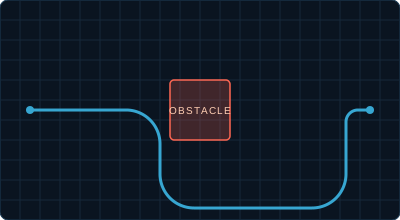
Any control with obstacle: true is something every auto/smart/grid line routes around automatically — no per-line config needed.
Automatic Bundling
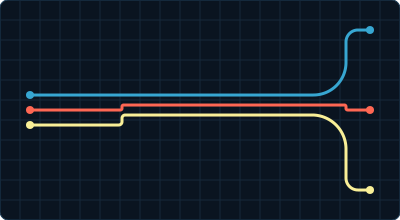
Lines heading the same general direction, running close enough to each other, merge into a shared corridor — riding evenly-spaced lanes — and branch apart again where their destinations actually diverge. This is entirely automatic: no channel, no config, just lines that happen to be going the same way.
Channels
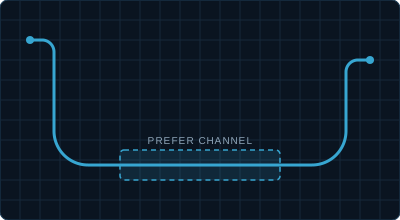
A channel is an authored corridor — a region you draw yourself that lines are rewarded for traveling through (mode: prefer), penalized for entering (avoid), or required to use (force). Where automatic bundling only happens between lines that are already naturally close, a channel can pull a line off a path it wouldn't otherwise take, when the discount makes it worthwhile.
Crossing Avoidance
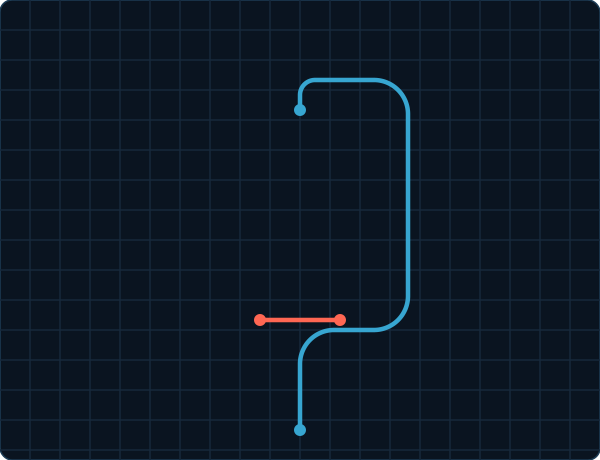
A line's path is penalized for cutting across another already-routed line's segment. It's a deterrent, not a wall — when stepping around is cheap, the router takes the detour; when the only alternative is a long way around, it crosses cleanly instead.
Where to Go Next
- Line Routing & Channels — every mode, field, and tunable default
- Line Overlay — per-line properties, styling, markers
- MSD Quick Start — build your first MSD, UI-only
- Routing Engine Architecture — internals: registries, lane assignment, the discovery loop